CDL Class Finder
Put in the ratings and get the class, with the reason.
OpenPart of Driver Files & Medical
One licence is a superset of the other. Class A covers everything a Class B covers, plus the heavy trailer. The real choice is whether the extra training and a harder skills test are worth it for the work you plan to do, and whether you want to go back for them later.
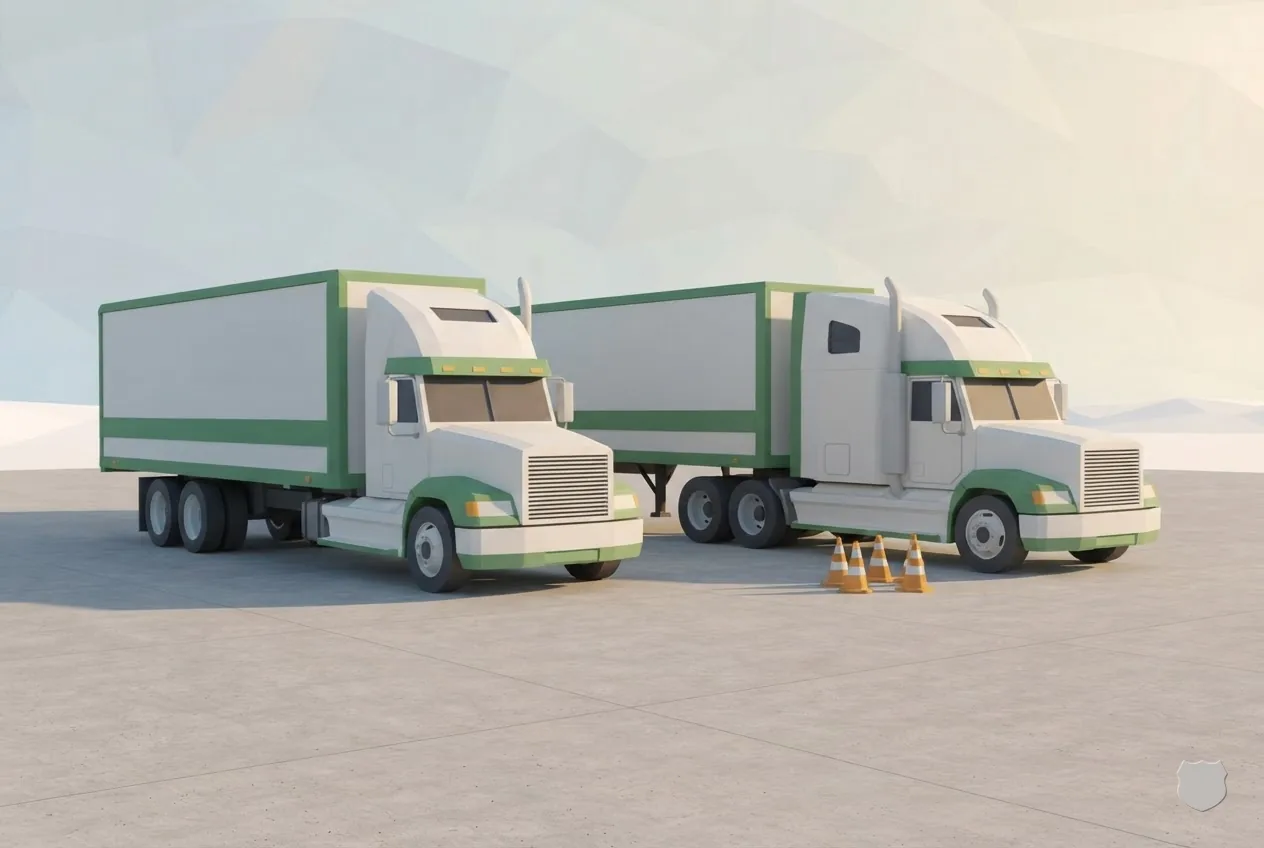
| Criterion | If unsureClass A | Class B |
|---|---|---|
| Vehicle group | Combination vehicle (§383.91(a)(1)) | Heavy straight vehicle (§383.91(a)(2)) |
| The weight test | GCWR 26,001 lb+, towed unit over 10,000 lb | GVWR 26,001 lb+, towing up to 10,000 lb |
| Also covers, with endorsements | Class B and Class C vehicles | Class C vehicles |
| Trailer rated over 10,000 lb | Yes | No |
| Training curriculum | Part 380, appendix A | Part 380, appendix B |
| Coupling and uncoupling taught | Yes, theory and range | Not in the curriculum |
| Theory pass mark | 80% | 80% |
| Minimum training hours | None set | None set |
| Knowledge tests | 20 general areas + 3 combination | 20 general areas |
| Skills test vehicle | A representative Group A rig | A representative Group B vehicle |
| Restrictions from the test vehicle | E, L, Z, and O on a non-fifth-wheel rig | E, L, Z |
| Passenger work at 16+ seats | Any bus, with P | Group B and C buses, with P |
E, L and Z come from the test vehicle on either class: an automatic transmission earns E, a vehicle without air brakes earns L, air-over-hydraulic earns Z. O is the Class A one. Test a Group A combination joined by a pintle hook instead of a fifth wheel and the licence will not cover a tractor-trailer until you retake all three skills tests in one.
Any combination rated 26,001 lb or more where the towed unit is rated over 10,000 lb. That is the tractor-trailer, but also a dump truck with a heavy tag trailer and a pickup with a big gooseneck. Under §383.91(c)(1) a Class A driver may also run Group B and Group C vehicles, provided they hold the endorsements those vehicles need.
The work it opens: long-haul and regional freight, flatbed, tanker work with the N endorsement, doubles with the T, plus every local job a Class B holder can take. Many carriers hiring for straight trucks will take a Class A applicant; the reverse is not possible.
A single vehicle rated 26,001 lb or more, towing nothing heavier than 10,000 lb. Dump trucks, box trucks, concrete mixers, garbage trucks, tow trucks, and city and school buses with the P or S endorsement. Under §383.91(c)(2) a Class B holder may also drive Group C vehicles with the right endorsements.
The appeal is local work and home most nights. The limit is hard, though: hook a trailer rated over 10,000 lb behind that dump truck and the rig is Class A, whatever the load weighs that day. Run your own rig through the CDL class finder if you are close to the line.
Since February 7, 2022, anyone getting a Class A or B for the first time, or upgrading to one, must finish training from a provider on FMCSA's Training Provider Registry before the skills test (§380.609). The two curricula share the same theory headings: basic operation, safe operating procedures, advanced practices, vehicle systems, non-driving activities. Class A adds coupling and uncoupling, both in the classroom and on the range.
There is no minimum number of hours for either class. The provider has to cover every unit, you need 80% overall on the theory assessment, and the instructor signs off your proficiency on the range and road. Outside the hazmat course, theory and behind-the-wheel have to be finished within 1 year of completing whichever part you did first. A school selling a fixed number of weeks is selling its own format, not a federal requirement.
The trap is the upgrade. Start on a Class B and move to A later and you go through entry-level training again for Class A, a Class A learner's permit, and every skills test again in a combination vehicle: §383.91(c) only excuses re-testing when you move down a class, never up.
Both classes take the same three parts under §383.113: the pre-trip inspection, basic vehicle control, and the on-road drive, all in a vehicle representative of the class. The Class A version is harder in practice. The pre-trip includes the coupling system and the trailer, backing covers a longer rig with a pivot point, and the knowledge tests add the three combination-vehicle areas on top of the general ones.
Whichever you take, the medical card comes first. The DOT physical paperwork explains what the examiner fills in and how it reaches the state, and the CDL requirements guide covers endorsements and the steps to the licence.
Once you are licensed, the driver qualification file is what a carrier builds around you, and the hours-of-service rules apply the same way on either class.
Put in the ratings and get the class, with the reason.
OpenEndorsements, restrictions and the steps to the licence.
The medical paperwork either class needs before the test.
The next decision once the licence is in hand.