DOT Drug Testing Rate Calculator
Random selections your pool owes this year, by quarter.
OpenPart of Driver Files & Medical
A DOT drug test is required by federal law for drivers in safety-sensitive jobs and is done exactly one way. A non-DOT test is one an employer chooses to run, under its own policy and state law. The cup can look the same. Who may be tested, what the lab looks for, which form travels with the sample and what a positive costs the driver are all different. A carrier can run both programs, as long as it keeps them apart.
| Criterion | The federal testDOT drug test | Non-DOT drug test |
|---|---|---|
| Required by | 49 CFR part 382, run under part 40 | The employer's own policy, within state law |
| Who can be tested | Only DOT-regulated employees, such as CDL drivers | Whoever the policy covers |
| Drugs tested | 5 classes, no more, no fewer | Whatever panel the policy names |
| Specimen | Urine in practice (oral fluid allowed, no lab certified yet) | Whatever the policy and state law allow |
| Paperwork | Federal Custody and Control Form | A non-federal form. The federal one is banned here |
| Laboratory | HHS-certified for that specimen type | Policy's choice |
| Medical review officer | Required before any positive is reported | Policy's choice |
| Alcohol violation | 0.04 or higher | Policy's threshold |
| After a violation | SAP evaluation, return-to-duty test, follow-up tests | Whatever the policy says |
| Reported to the Clearinghouse | Yes | No |
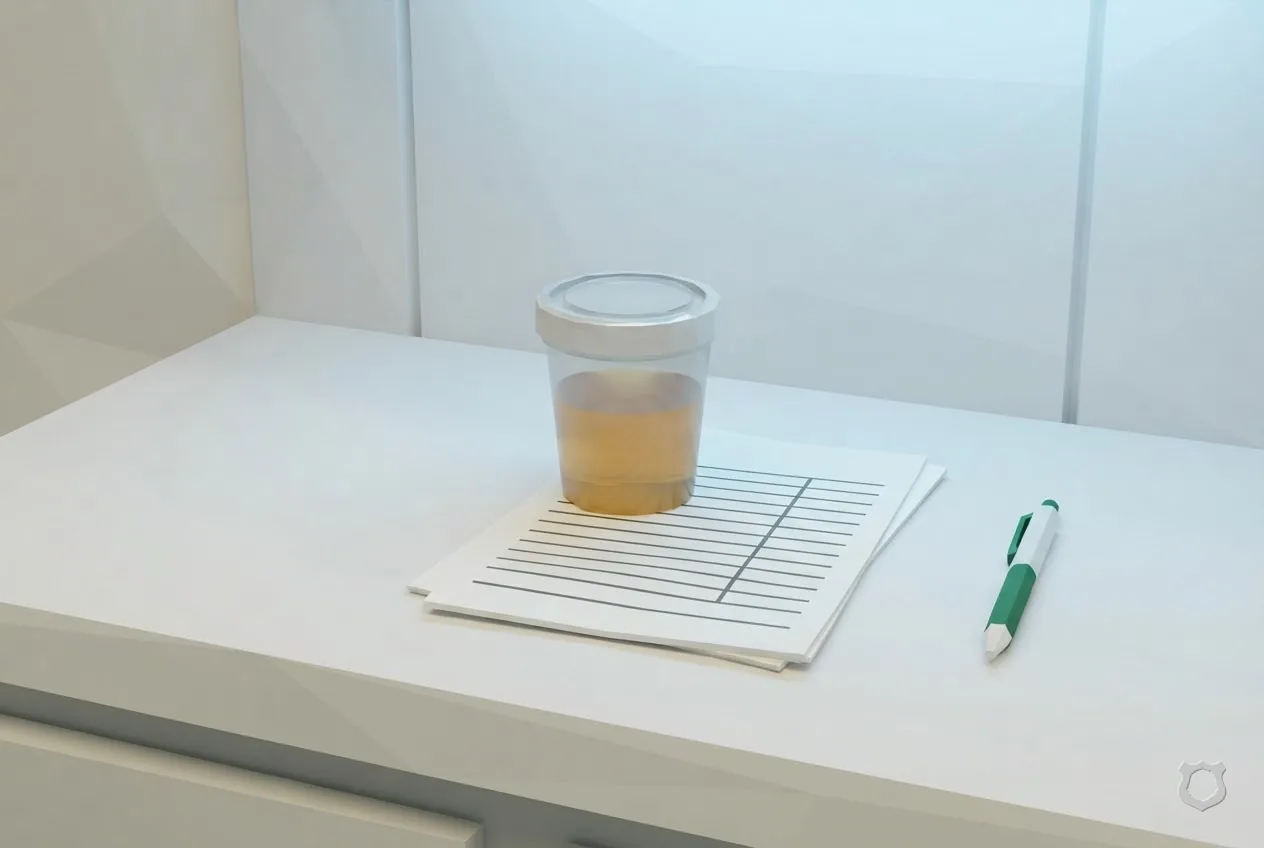
The collection looks the same in both cases: a cup, a collector, a sealed bottle. Everything after that is different. A DOT test runs on one federal procedure from collection to result. A non-DOT test runs on whatever the employer wrote down.
FMCSA's part 382 decides when a driver is tested. It covers anyone who drives a vehicle that needs a CDL. DOT's part 40 decides how the test is done, and it does not bend. The collector uses the Federal Drug Testing Custody and Control Form (CCF), never a non-federal or expired version. The specimen goes to a laboratory certified by HHS for that specimen type. The lab tests for 5 drug classes and is forbidden to test a DOT specimen for anything else.
| Drug class | Analytes | Initial cutoff, ng/mL | Confirm cutoff, ng/mL |
|---|---|---|---|
| Marijuana metabolites | THCA | 50 | 15 |
| Cocaine metabolites | Benzoylecgonine | 150 | 100 |
| Amphetamines | Amphetamine, methamphetamine, MDMA, MDA | 500 | 250 |
| Opioids | Codeine, morphine, 6-AM, hydrocodone, hydromorphone, oxycodone, oxymorphone | 10-2,000 | 10-2,000 |
| Phencyclidine | PCP | 25 | 25 |
Those are the urine cutoffs in §40.85. Opioid cutoffs vary by analyte, from 6-acetylmorphine at the bottom to codeine and morphine at the top. A lab result is not yet a result. A medical review officer (MRO) has to interview the driver and check for a legitimate medical explanation, such as a valid prescription, before anything reaches the employer. The driver can be given up to 5 extra days to produce evidence.
Urine or oral fluid? Since 2023, part 40 has allowed oral fluid. But a DOT lab must be HHS-certified for each specimen type, and HHS's list of 30 September 2026 shows 0 labs certified for oral fluid. Until that changes, a DOT drug test is a urine test.
The program around the test is part 382. Random rates are set at 50% for drugs and 10% for alcohol. An owner-operator who employs only himself must still sit in a random pool of 2 or more drivers, which in practice means a consortium. The DOT testing guide covers the six test reasons. The rate calculator turns a pool size into selections per quarter.
A non-DOT test is any drug test an employer runs under its own policy rather than under federal rules. That includes tests for mechanics, dispatchers and warehouse staff, and the company's own policy tests for drivers. The employer chooses the panel, the specimen type, the lab and the consequences. State law sets the limits. Some states regulate workplace testing closely and some barely at all, and the rules on marijuana in particular differ from state to state. Check your own state before writing a policy.
That freedom works both ways. A non-DOT panel can include drugs DOT never tests for. It cannot borrow DOT's authority: it never uses the federal form, and a positive result is a matter for the job, not a violation reported to the Clearinghouse.
Many carriers run both programs, and some drivers get both tests on the same visit. Section 40.13 sets the rules for that:
The last rule is where the two physicals and the two drug tests get confused. A urine sample given at a physical is not a DOT drug test. If the employer needs one, it is a separate collection on the federal form.
This is where the two tests are furthest apart. A non-DOT positive costs the job or the offer, as far as the policy and state law allow. A DOT violation stays with the driver. That means a verified positive, a refusal (including an adulterated or substituted specimen), or an alcohol result of 0.04 or higher. It bars the driver from safety-sensitive work for every DOT employer until a substance abuse professional (SAP) has evaluated them and the prescribed education or treatment is done. Then comes a directly observed return-to-duty test, which must be a drug negative and/or an alcohol result below 0.02.
Out-of-service risk. A state medical marijuana card, a doctor's recommendation or a hemp product does not explain away a DOT marijuana positive. Part 40 tells the MRO not to accept any of them, whatever state law says about the same driver off duty.
Random selections your pool owes this year, by quarter.
OpenThe six test reasons and who has to be in the random pool.
Where DOT violations are recorded and who can query them.
The other DOT/non-DOT pair drivers mix up.
Where the testing paperwork lives at audit time.